There Is No Such Thing as a “Steel Mill Motor”
There is No Such Thing as a "Steel Mill Motor"
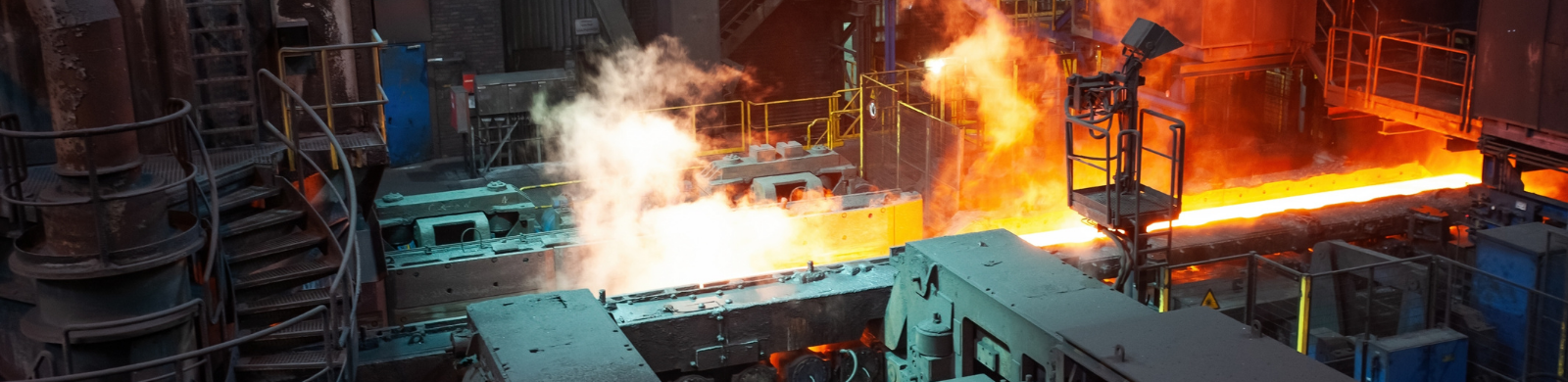
Walk through a steel mill and you may see hundreds of electric motors.
Calling all of them simply “steel mill motors,” however, misses the point. While motors can certainly be designed specifically for steel-mill applications, the applications within the mill are anything but uniform.
A motor lifting a coil from an overhead crane has very little in common with one driving a conveyor, circulating cooling water, or controlling a rolling process. Marathon® Electric's Roller Table motors, for example, are specifically designed for the demanding operating conditions associated with steel-mill rolling applications. A crane, pump, or conveyor presents an entirely different set of requirements.
These motors may operate under the same roof—and two may even carry the same horsepower rating—but what is being asked of them can be radically different.
That distinction matters because horsepower alone does not define a motor application. The U.S. Department of Energy specifically identifies assessing operating conditions, selecting the right motor for different applications, and using variable-speed control where demands vary among its key motor-system efficiency practices.
A steel mill, then, is not one motor application.
It is dozens of them.
And taking a closer look at just a few reveals why understanding the job can be every bit as important as understanding the nameplate.
Horsepower Doesn't Tell the Whole Story
The easiest way to see that distinction is to compare two motors that look similar on paper.
Imagine two motors.
Both are rated at 50 horsepower.
The first drives a conveyor. It operates for extended periods at relatively stable speed, moving material through a dusty environment and occasionally starting under load.
The second operates an overhead crane. It repeatedly starts, accelerates, lifts changing loads, slows, positions them, and stops.
On paper, both may say 50 HP.
From an application standpoint, however, they are not interchangeable simply because that number matches.
Motor selection can also depend on duty cycle, torque characteristics, starting requirements, speed range, environmental conditions, enclosure, temperature, contamination, mechanical loading, control requirements, and whether the application will operate from a VFD. DOE motor-system guidance emphasizes precisely this system-level approach: evaluate the operating conditions and select the motor according to the needs of the application.
That's why asking “How much horsepower do I need?” is only the beginning.
The more useful question is:
“What am I asking this motor to do?”
One Mill. Many Motor Applications.
That application-first approach can also be seen across Marathon Electric's steel solutions portfolio.
Some steel mill applications call for highly specialized motor designs. Marathon® Electric's Roller Table motors, for example, are specifically designed for the demanding operating conditions found in steel mill applications. Other equipment throughout the same facility presents very different requirements.
Blue Chip XRI® Severe Duty motors support demanding industrial environments, while Black MAX® inverter-duty motors are designed for applications requiring operation with variable-frequency drives. Other Marathon solutions extend into applications where efficiency, speed control, severe-duty construction, or specialized operating characteristics become priorities.
That range is precisely the point: one steel mill can contain many fundamentally different motor applications.
A conveyor needs to keep material moving. An overhead crane must repeatedly lift, position, and stop changing loads. Pumps keep cooling water and process fluids circulating. Roller tables present their own specialized operating demands. Rolling and process equipment can require precise control of speed and torque.
The motor selection follows the job—not simply the industry surrounding it.
Conveyor: Keep It Moving
Conveyors perform one of the most fundamental jobs inside a steel operation: moving material from one process to the next.
Depending on where they are located, they may transport raw materials, scrap, slabs, billets, finished products, or other materials through the facility. Their job sounds simple—keep material moving—but the demands placed on the motor can be anything but.
Those operating conditions help determine what type of motor belongs on the conveyor. Marathon® Electric’s Globetrotter® motors can serve general-purpose conveyor applications, while more demanding areas of a steel facility may call for severe-duty designs such as Blue Chip® XRI®. Specialized material-handling applications can require an even more application-specific solution; roller tables, for example, place distinct mechanical and operating demands on their motors and can be served by Marathon’s dedicated Roller Table motor designs.
For the motor, reliability is therefore not simply a question of whether it can produce enough horsepower. The application may also require consideration of starting conditions, load characteristics, duty cycle, enclosure, ambient environment, and how consistently the equipment is expected to operate.
And because conveyors frequently connect one stage of production to another, their importance can extend well beyond the conveyor itself.
If material cannot move forward, neither can the process.
Crane: Start. Stop. Lift. Position. Repeat.
Move across the mill to an overhead crane and the motor's job changes completely.
Instead of maintaining relatively continuous motion, crane applications repeatedly create and control motion.
Start.
Accelerate.
Lift.
Position.
Decelerate.
Stop.
Then do it again.
A crane moving coils or other heavy materials may require substantial torque during acceleration while also demanding controlled braking and accurate positioning. The load can vary significantly from one lift to the next, and the motor may experience frequent starts and stops rather than continuous operation.
That creates a very different duty profile from the conveyor a few hundred feet away.
The distinction illustrates why duty cycle matters. A motor's thermal behavior is affected not only by the load it carries, but by how it operates over time. Repeated acceleration and starting events impose different electrical and thermal demands than steady operation at a relatively constant load.
That difference also influences motor selection. Applications requiring variable-speed operation may call for motors specifically designed for inverter duty. Marathon® Electric's BlackMAX® and BlueMAX® motor families are designed for operation with variable-frequency drives, providing options for applications where precise speed control, high-performance operation, or demanding duty cycles are part of the system requirements.
In a crane application, that can become particularly important because the motor is not simply being asked to run—it may be asked to accelerate a load, change speed, position it accurately, decelerate, stop, and repeat the cycle throughout its operating period. The motor and drive therefore function as part of a motion-control system whose requirements can be very different from those of a continuously operating conveyor.
A conveyor motor and a crane motor might therefore share a horsepower rating while living very different working lives.
The number on the nameplate tells only part of the story.
Pump: Quietly Critical to the Process
Then there are the motors that rarely receive much attention at all.
Pumps are used extensively throughout industry for cooling and lubrication, fluid transfer, and hydraulic systems. The Department of Energy notes that many manufacturing facilities depend on pumping systems for their daily operations.
Inside a steel facility, that can make a pump motor quietly critical.
Cooling water must circulate. Process fluids must move. Hydraulic systems must maintain pressure. A pump may run continuously for long periods, and depending on the system's needs, its required flow may vary throughout operation.
That introduces another consideration: speed control.
For pumping systems with variable flow requirements, variable-speed control can allow motor speed to follow system demand rather than relying solely on mechanical throttling. DOE guidance specifically identifies variable-speed control as an important strategy for variable-flow pumping applications.
That is where the motor and control have to be considered as a system rather than as separate components. Marathon Electric offers pump-duty motor solutions for applications requiring dependable operation in pumping systems, while the ControlMax™ family of AC drives provides variable-speed control for applications such as pumps, fans, and general-purpose machinery. Together, the motor and drive can be selected around the actual operating requirements of the pumping system—including whether the application needs continuous operation at a relatively stable speed or must respond to changing process demand.
And that brings us back to the larger point.
Now compare that motor with the crane.
One may spend hours maintaining a relatively stable process flow.
The other repeatedly accelerates and decelerates a changing load.
Same facility.
Potentially similar horsepower.
Entirely different job.
Rolling and Process Equipment: When Control Matters as Much as Power
Move deeper into the production process and the demands change again.
Rolling and other process applications do not necessarily ask only whether a motor can move a load. They may ask whether it can move that load at the right speed, with the right torque, at the right moment.
That distinction becomes particularly important in variable-speed applications.
Variable-frequency drives allow AC motor speed to be adjusted electronically, enabling motor operation to respond to changing process requirements. Marathon Electric's ControlMax™ AC drives provide variable-speed control for applications where operating conditions require the motor to respond to changing system demands. DOE notes that VFDs are the most common form of variable-speed drive used with AC induction motors and that variable-speed systems can improve the ability of equipment to match changing loads.
But adding a VFD also introduces another set of considerations.
The motor must be appropriate for inverter operation, and engineers may need to consider speed range, torque requirements, cooling at reduced speeds, acceleration and deceleration, and the characteristics of the driven equipment.
For some processes, simply producing enough mechanical power is not the difficult part.
Controlling that power is.
From the outside, a steel mill may look like one enormous manufacturing operation. From a motor's perspective, it is anything but.
One motor spends its life moving material. Another lifts it. Another circulates the water that keeps the process cool. Another helps control speed and torque as steel moves through production.
They may share a facility.
They may even share a horsepower rating.
What they don't share is a job.
And ultimately, that's what defines the motor application.
Explore Steel Applications
Learn how Marathon Electric motor technologies support conveyors, pumps, material handling, variable-speed equipment, and other applications throughout steel production.
Visit our Literature page to find the Steel Industry Solutions Guide and explore Marathon Electric resources for steel applications.